Key takeaways
- Google ranks local results on relevance, distance and prominence, and says no one can pay for a better local ranking.
- Distance depends on where the searcher is, so a business ranks differently from block to block.
- Agencies influence relevance and prominence: profile, website, reviews and local links.
- Measure map positions with a grid across the service area, not a single search from the office.
SEO maps work, or Google Maps SEO, is the part of local SEO that decides whether a client appears in the map results and the local pack. It is the core of our white label local SEO service, and it starts with how Google says it ranks local results.
How does Google rank businesses on Google Maps?
Google's Business Profile help page says local results are based mainly on three factors. Relevance is how well a profile matches the search. Distance is how far the business is from the searcher or the location in the query. Prominence is how well known the business is, including reviews, ratings and links from other websites.
The same page on improving your local ranking states that there is no way to request or pay for a better local ranking, and that businesses with complete and accurate information are more likely to show. Those two sentences are worth quoting in every local SEO proposal.
| Factor | What it means | What an agency can do |
|---|---|---|
| Relevance | How well the profile and site match the search | Accurate categories, services, descriptions and matching location pages |
| Distance | How far the business is from the searcher | Little: report it honestly and set service areas correctly |
| Prominence | How well known the business is | Real reviews and replies, local links, mentions, a strong website |
Why does a client rank in one street and not the next?
Because distance is measured from the person searching, or from the place named in the search. A dental clinic can hold a top position for searchers a few blocks away and disappear a few kilometers out, where competitors are closer. That is normal, and it is why a single ranking from the office address is a misleading report.
No legitimate tactic moves a business closer to the searcher. Creating addresses where the business has no staffed location breaks Google's guidelines for representing your business and is one of the common causes of suspension covered in our Business Profile suspension guide. Service-area businesses should set their areas as Google describes in managing service areas, knowing that the area setting does not override distance.
Building relevance: profile and website
Relevance comes from what the business tells Google and what its website confirms. The profile side, from primary category to services and hours, is covered in depth in our Google Business Profile audit checklist, so here we focus on the website, which many map projects ignore:
- The profile links to a matching location page, not always the home page, with the same name, address and phone.
- Each service the client wants to rank for has its own page with real detail, not a list of keywords.
- Multi-location clients have one useful page per real location; see location pages that are not doorways.
- LocalBusiness structured data on location pages, following Google's local business structured data documentation. Our LocalBusiness schema guide has the details.
How can agencies improve prominence?
By making the business better known in its real community. That means asking every real customer for a review and replying to them, earning links and mentions from local media, associations, suppliers and sponsorships, and keeping listings accurate. Google says more reviews and positive ratings can help local ranking. Buying reviews or links does the opposite.
Fake reviews break Google's Maps user-generated content policy and, in the US, the FTC's rule on consumer reviews and testimonials. Paid links that pass ranking credit are listed as link spam in Google's spam policies. Prominence takes months to build; that is the honest timeline to give the client.
How do you measure Google Maps rankings?
Use a position grid: a map of the service area with points every few blocks or kilometers, showing where the business ranks for a target search from that spot. Run it before work starts and monthly after, for the same keywords and grid. Add Business Profile calls, direction requests and website clicks so the report shows leads, not only positions.
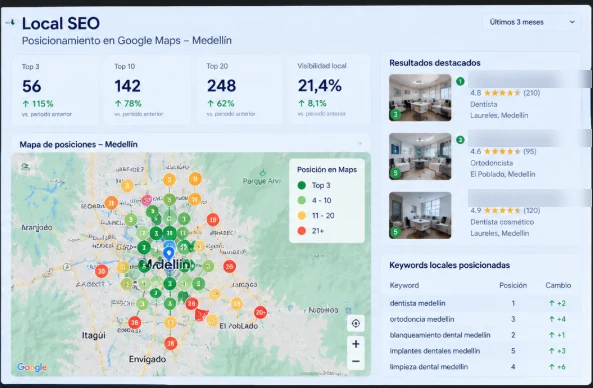
That grid is from a local dental client we work with in Medellín, the same result shown on our home page. The pattern is typical: strong positions near the clinic, weaker ones toward the edges of the grid where closer competitors win on distance. A grid lets the client see where the work is paying off and where distance sets the limit, which is a far better conversation than a single number.
Map results, local pack and the client's own searches
The same ranking factors decide the map inside Google Maps and the local pack in regular search results, but the two can show different results, and both change with the searcher's location, device and wording. Clients often check by searching from their own office or phone, where distance favors them and their history may shape what they see. Explain early that a self-search is not a measurement, and send them the grid instead. It saves a monthly debate about whether the work is working.
Setting expectations with clients
- No guarantees. Google says rankings cannot be bought or requested. Promise the work, not a position.
- Report the whole grid. Explain that distance limits reach, and show progress across the area.
- Connect to leads. Calls and direction requests matter more to the client than rank.
- Plan in quarters. Profile fixes can show quickly; reviews and links take longer.
We deliver Business Profile work, location pages, map grids and monthly reports under your brand through white label local SEO, part of our white label SEO services.
Frequently asked questions
Is Google Maps SEO different from local SEO?
It is a part of it. Local SEO also covers local organic results and the website; Maps SEO focuses on the map and local pack.
Can we rank a client in a city where they have no office?
Not with a fake address. A service-area business can set its real service areas, but distance still affects results.
Do Business Profile posts improve map rankings?
Google does not list posts as a ranking factor. Treat them as useful content for people viewing the profile.
How many keywords should a map grid track?
Start with the three to five searches that bring the most valuable calls, and keep them stable so months can be compared.
Does the website affect Google Maps rankings?
Google says prominence includes links to the business, and the site confirms relevance. A strong location page supports the profile.

About the author
Juan José Giraldo is a senior SEO specialist with 5+ years of experience. He works on technical and local SEO for 600+ US car dealerships and supervises the SEO of 18 US e-commerce stores. He runs White Label SEO LATAM from Medellín, Colombia, and delivers white label SEO for agencies in the US, UK, Canada and Australia. Read more · LinkedIn.
Sources
- Business Profile Help, Tips to improve your local ranking on Google
- Business Profile Help, Guidelines for representing your business on Google
- Business Profile Help, Manage your service areas for service-area and hybrid businesses
- Google Search Central, Local business (LocalBusiness) structured data
- Maps User Generated Content Policy, Prohibited and restricted content
- eCFR, 16 CFR Part 465: Rule on the Use of Consumer Reviews and Testimonials
- Google Search Central, Spam policies for Google web search